Social Security Wage Base Hits $192,300 in 2027: What Small Business Owners Need to Do Now
Social Security Wage Base Hits $192,300 in 2027: What Small Business Owners Need to Do Now
The numbers behind your 2027 payroll budget just landed, and prices are moving the wrong way. If you set wages, quote jobs, or plan to apply for funding next year, this week's news changes your math. Here is what happened and what to do about it.
This Week in Bookkeeping & Payroll
1. The 2027 Social Security wage base jumps to $192,300
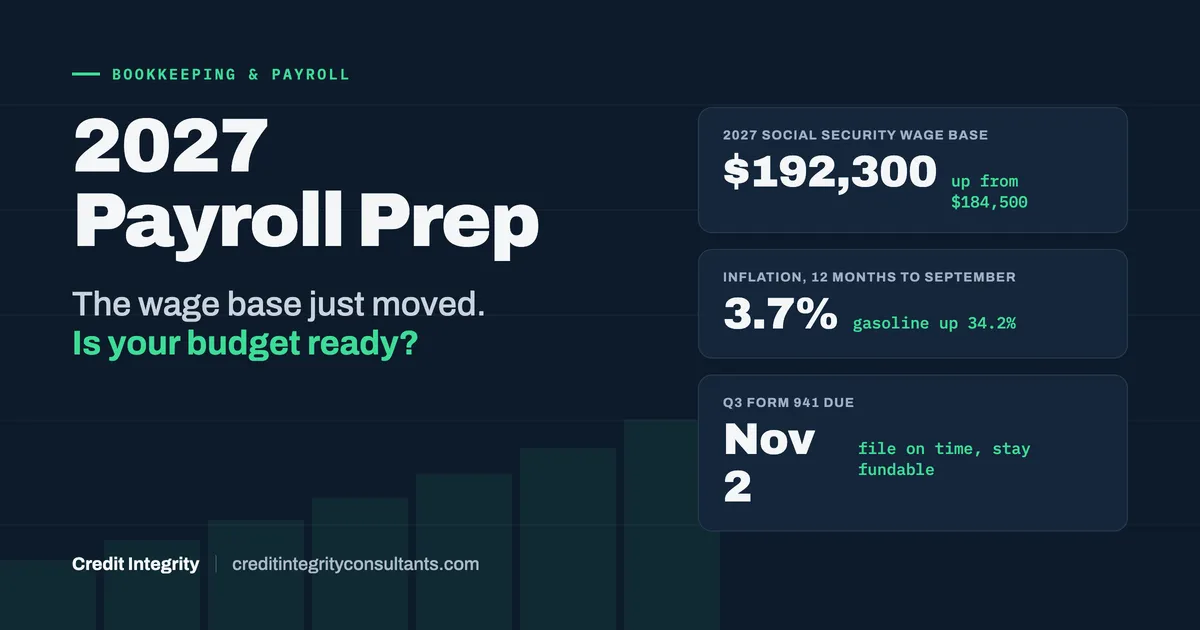
What happened: On October 14, the Social Security Administration announced that wages subject to the 6.2% Social Security tax will rise to $192,300 in 2027, up from $184,500 in 2026. The maximum Social Security tax per worker climbs to $11,922.60 for the employee and the same amount for the employer, up from $11,439. The 1.45% Medicare tax is unchanged and still has no wage cap, and the additional 0.9% Medicare tax still kicks in above $200,000 for single filers. Benefits get a 3.6% cost-of-living increase starting in January.
Why it matters: Every employee who earns more than $184,500, including an S corporation owner paid through payroll, costs you up to $483.60 more in employer Social Security tax next year. Self-employed owners pay both halves on net earnings up to the new limit.
What to do: Confirm your payroll provider will load the new wage base for the first 2027 pay run. Add the increase to your 2027 payroll budget now, and if you pay yourself a salary through an S corporation, review it with your tax professional before January.
2. Inflation hit 3.7% and small business confidence slipped
What happened: The Bureau of Labor Statistics reported on October 14 that consumer prices rose 0.6% in September and 3.7% over the past 12 months. Gasoline rose 9.1% in September alone and is up 34.2% from a year ago. Core inflation, which strips out food and energy, was 2.6%. A day earlier, the NFIB Small Business Optimism Index fell 0.8 points to 97.9, just under its 52-year average of 98.0. Its Uncertainty Index rose to 90, and 26% of owners named labor quality as their top problem.
Why it matters: Fuel, delivery, and travel costs are climbing faster than most price lists get updated. If you quote jobs off last spring's numbers, your margin is shrinking and your P&L may not show it until it is too late.
What to do: Pull gross margin by service or product for the last three months and compare it to the same period last year. If fuel and vehicle costs sit inside one catch-all expense account, split them out so you can see the trend and price for it.
3. AI assistants are now reading your accounting data
What happened: On October 13, Xero launched a connected app that brings live Xero data into Google Gemini. Users can ask for profit and loss statements, overdue receivables, outstanding bills, and charts in a chat. Any action that changes financial data, such as sending an invoice, requires explicit confirmation, and Xero says shared data is not used to train Gemini models. Separately, Gusto repackaged its plans on October 1, adding expense tracking, reimbursements, and time off management to its Simple plan with no change to plan prices.
Why it matters: An AI assistant is only as accurate as the books it reads. Ask a question about unreconciled books and you get a confident, wrong answer.
What to do: Reconcile before you rely on any AI summary. Limit who can connect accounting or payroll data to outside apps, and review those connections the same way you review user access.
Tips to Keep Your Books Clean
Build your 2027 payroll budget before Thanksgiving. Start with headcount and raises, then layer in the new Social Security wage base and your state rates. Some states have already moved: New York's paid family leave premium rises to 0.452% of wages in 2027, from 0.432%. A budget built in November beats a surprise in February.
Give fuel and vehicle costs their own accounts. With gasoline up 34.2% in a year, burying it in "miscellaneous" hides the fastest-rising cost many service businesses have. Separate accounts show you when to adjust pricing or surcharges.
Close the month within 15 days. Reconcile bank, credit card, loan, and payroll clearing accounts every month. Monthly closes catch errors while they are small and give you numbers you can actually manage from, or feed into any reporting tool.
Treat on-time payroll taxes as a funding asset. Lenders underwrite your financial statements, tax returns, and bank activity, and they look for those three to tell the same story. Missed payroll tax deposits trigger penalties and, if left unpaid, can lead to a federal tax lien that shows up in underwriting. Clean books and on-time payroll are the foundation of a strong business credit profile and a fundable file.
Keep owner pay on the books, not in the bank app. Run owner salary through payroll and record distributions in their own equity account. Lenders and tax preparers both need to see exactly what the business earned and what you took out.
Upcoming Deadlines
Date | What is due | Who it applies to |
|---|---|---|
Nov 2, 2026 | Form 941 for Q3 (July to September). October 31 falls on a Saturday, so the deadline moves to Monday | All employers filing quarterly |
Nov 2, 2026 | Q3 FUTA deposit, if accumulated FUTA liability is over $500 | Employers who pay federal unemployment tax |
Nov 10, 2026 | Form 941 for Q3, if all Q3 tax was deposited on time and in full | Employers current on deposits |
Nov 15, 2026 | Massachusetts HIRD filing window opens (filing due December 15) | Massachusetts employers with 6 or more employees |
Looking ahead: the $192,300 Social Security wage base takes effect with your first 2027 pay run.
Start 2027 With Books You Can Stand Behind
A higher wage base and rising costs reward the owners who see their numbers early. Credit Integrity handles your bookkeeping and payroll so filings go out on time, your 2027 budget reflects the new rules, and your financials are ready the moment a lender asks. Our bookkeeping and payroll services come bundled with business credit consulting and the Lendavo funding-readiness platform, so the same clean books that keep you compliant also build your path to capital.
Book a consultation at creditintegrityconsultants.com and walk into 2027 ready.
This post is for educational purposes only and is not tax or legal advice. Consult a qualified tax professional about your specific situation.
Sources
Social Security wage base and COLA announced for 2027 (Journal of Accountancy)
Social Security Wage Base Increases to $192,300 for 2027 (American Payroll Association)
Consumer Price Index, September 2026 (U.S. Bureau of Labor Statistics)
ABA DataBank: NFIB Small Business Optimism Index ticks down in September (ABA Banking Journal)
Xero Announces Google Gemini Integration (CPA Practice Advisor)
What's new with Gusto plans starting October (Gusto Help Center)
