Tighter SBA Rules, Higher Rates: How Business Owners Can Stay Funding-Ready This Fall
Tighter SBA Rules, Higher Rates: How Business Owners Can Stay Funding-Ready This Fall
Money just got more expensive and SBA loans just got harder to close. In the same few weeks, mortgage pricing rules for personal credit scores started shifting and a fourth business credit bureau became easier to see. Here is what changed, why it matters to your next application, and what to do about it before year end.
This Week in Credit & Funding
1. New SBA 7(a) rules took effect October 1
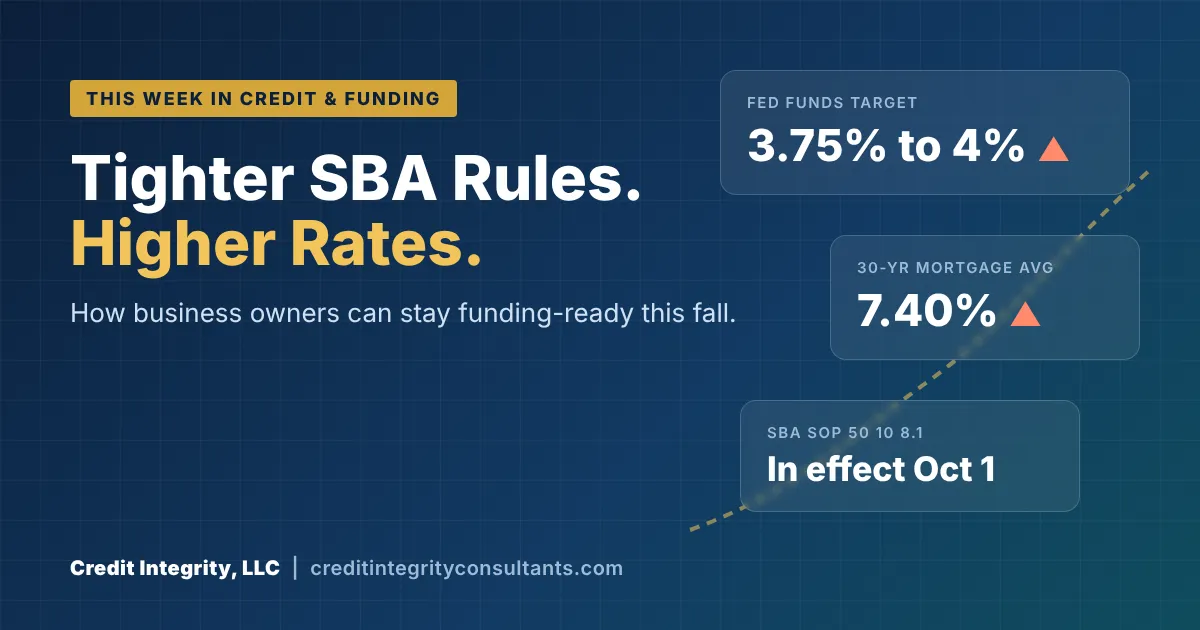
What happened: SBA's updated loan program rulebook, SOP 50 10 8.1, took effect October 1, 2026. As Forbes reported, SBA loans of $350,000 or less used to buy a business can no longer go through SBA Express and now require standard 7(a) underwriting. Acquisition loans of $3 million or more now require a quality of earnings report. Equity investors cannot recoup their cash injection until the loan is fully repaid, and only U.S. citizens now qualify as borrowers, investors, or key employees. Forbes also reported 7(a) loan counts fell almost 30% in fiscal 2026.
Why it matters: The rule in effect on your approval date governs your loan. A deal that worked in September may not work now, and timelines on small acquisitions can stretch from a few weeks to roughly three months.
What to do: If you are buying a business, build three extra months into your closing timeline, get clean accrual-basis financials now, and ask your lender which SOP version applies to your file before you sign a purchase agreement.
2. The Fed raised rates, and mortgage rates hit 7.40%
What happened: On September 16, the Federal Reserve raised the federal funds target range by a quarter point to 3.75% to 4.00%. The meeting minutes, released October 7, show most officials expect another increase "would likely be appropriate by year end." Fed staff noted credit "appeared to be somewhat tight for private credit loans and small businesses." On October 8, Freddie Mac reported the 30-year fixed averaging 7.40%, up from 7.28% the prior week.
Why it matters: Many business lines of credit and variable-rate SBA 7(a) loans are priced off Prime, which moves with the Fed. Every hike raises your payment and shrinks the loan amount your cash flow can support. Commercial real estate and DSCR investors feel it through tighter coverage math.
What to do: Recalculate your debt service coverage at today's rate plus 0.50%. If a line of credit renewal is coming, start that conversation now, while your financials still show the numbers you want a lender to see.
3. FHFA moves toward one credit score pricing grid
What happened: On September 28, FHFA Director Bill Pulte said Fannie Mae and Freddie Mac will combine their separate pricing grids for FICO and VantageScore 4.0 into one grid, ending the downward pricing adjustment VantageScore loans carried. As of this writing, no effective date or new pricing matrix has been published.
Why it matters: Business owners often buy property personally, refinance to pull capital, or sign personal guarantees that lenders evaluate with consumer scores. Two scoring models are headed toward equal weight in conventional mortgage pricing, and they do not always produce the same number for the same file.
What to do: Know both of your scores, not just one. Review all three personal credit reports for accuracy, and keep revolving balances low on cards that report in your name.
4. Nav adds Creditsafe as a fourth business bureau
What happened: On October 14, Nav announced that Creditsafe Risk Scores and reports are now available to Nav Prime users, alongside Dun & Bradstreet, Experian, and Equifax data. Creditsafe vendors can also apply to join Nav's net-30 marketplace.
Why it matters: Suppliers and some lenders pull Creditsafe when deciding trade terms. If your profile is thin or wrong there, you may be denied terms without knowing why.
What to do: Check whether your business has a Creditsafe file, confirm that your legal name, address, and EIN details match across every bureau, and prioritize net-30 vendors that report your payments.
Underwriter's Take
When I underwrote commercial loans, the credit score was rarely the deciding factor. Cash flow was. In a rising rate environment, underwriters stress your debt service coverage at higher rates, and a borrower who barely clears 1.25x today can fall below it on paper after one more hike. The files that moved fastest had three things in common: tax returns that matched the bank statements, a personal credit profile with low utilization and no surprises, and a business credit file that showed a real payment history. Underwriters do not reward stories. They reward documents that agree with each other.
Action Steps This Week
Pull all of your reports. Get your three personal credit reports and your business reports from Dun & Bradstreet, Experian, Equifax, and now Creditsafe. Flag anything inaccurate or outdated.
Run your coverage math. Divide your annual net operating income by your annual debt payments, then rerun it with rates 0.50% higher.
Lock down your financials. Close your books monthly and reconcile bank statements to your tax returns. Lenders will ask, and SBA acquisition deals now demand more.
Separate business and personal debt. Add vendor and business card accounts that report to business bureaus, so your personal utilization is not carrying your company.
Time your applications. If you need a line of credit or SBA loan in the next six months, start the process now rather than after another possible rate move.
Get Funding-Ready With Credit Integrity
Rules are tightening, and preparation is the advantage. Start with a Business Credit Assessment or book a consultation with Credit Integrity to see where your business credit, personal credit, and financials stand. Then use Lendavo to track your Funding Ready Score and SBA Readiness Score, and let FundSmart AI match you with funding options that fit your profile.
This post is for educational purposes only and is not legal, tax, or financial advice.
