Stop Sleeping on Your Business Credit Scores
Stop Sleeping on Your Business Credit Scores
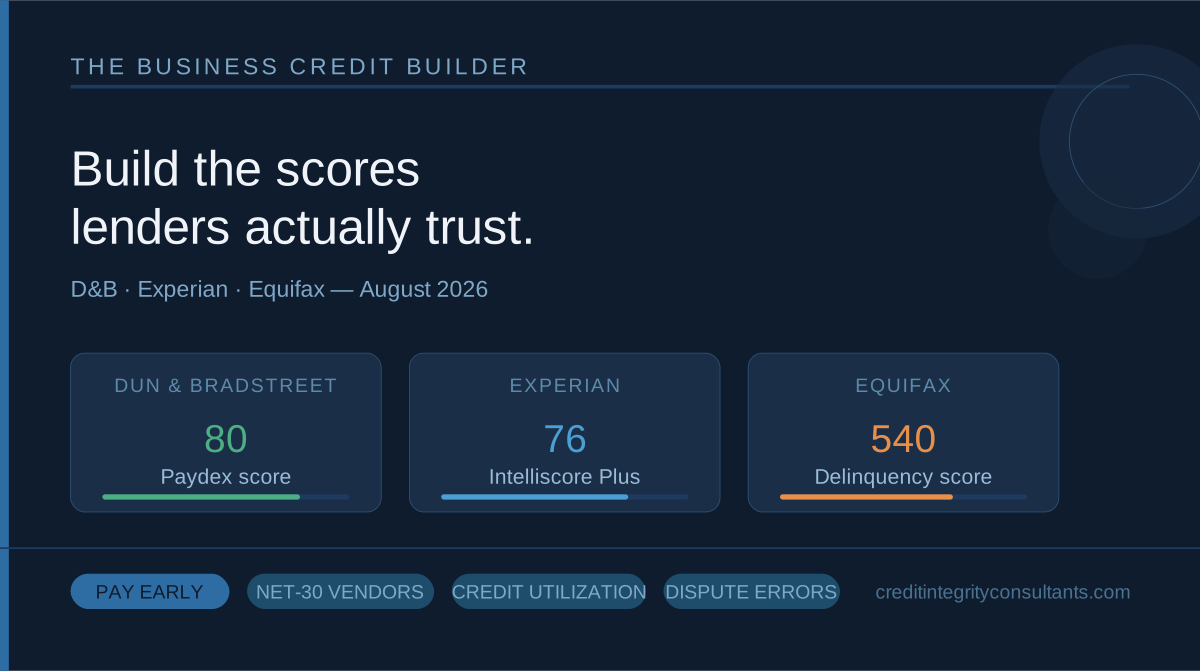
If you are running a business and you have not checked your business credit profiles lately, now is the time. Your D&B Paydex score, Experian Intelliscore Plus, and Equifax Business Delinquency Score are being pulled by lenders, suppliers, insurance providers, and even potential partners without you knowing it. What those reports say about you determines whether you get approved, at what rate, and on what terms.
The good news: all three scores are buildable. And they respond faster than most business owners expect when the right moves are made consistently.
Score #1: Dun and Bradstreet Paydex
The D&B Paydex score does one thing: measure how quickly you pay your bills relative to terms. That is it. Pay early and consistently, and the score goes up. Pay late, even once in a while, and it drops.
How to move the needle:
The fastest path to a higher Paydex is opening three or more accounts that report to D&B, then paying every account the day the billing statement or invoice arrives. Not on the due date. The day it arrives. That early payment signals to D&B that you are a low-risk account.
Before you open any account, ask them directly: "Do you report to Dun and Bradstreet?" If they do not, the account will not help your score, no matter how faithfully you pay.
One more thing: verify that D&B has your business listed with accurate information. A misspelled business name, wrong address, or outdated SIC or NAICS code can slow down reporting or cause mismatches that suppress your file. Claim your D-U-N-S Number for free at dnb.com and review your profile.
Score #2: Experian Intelliscore Plus
Experian runs two versions of this score. Intelliscore Plus V2 & V3 are equally important. Both scores predict the likelihood of serious payment delinquency over the next 12 months.
What sets Intelliscore Plus apart from Paydex is that it pulls in more data points: payment history, credit utilization, the age of your accounts, public records, and importantly, your personal credit as an owner. In the early stages of business credit building, your personal profile carries weight here, so a strong personal score gives you a head start.
What moves this score:
Keep business credit card and revolving account balances below 30% of your available limit. Lenders and Experian's models see high utilization as a sign of strain, even if you pay in full monthly. Spread purchases across multiple accounts rather than maxing one card.
Pay every tradeline on time. Intelliscore Plus is especially sensitive to recent delinquencies. One 30-day late payment can knock 20 or more points off your score.
Monitor your Experian Business report at least quarterly and dispute any inaccurate entries. Experian's online dispute process accepts supporting documents like bank statements, cancelled checks, and invoices. Use them.
Score #3: Equifax Business Delinquency Score
Equifax takes a different approach. Their Commercial Insight Delinquency Score specifically predicts the likelihood that your financial trade accounts will become severely delinquent, defined as 91 days or more past due, within the next 12 months. Lenders use this score to assess credit risk on new applications and renewals.
Why this matters for entrepreneurs:
If you are applying for a business line of credit, equipment financing, or a commercial term loan, the underwriter often pulls your Equifax commercial file alongside D&B and Experian. A poor score can result in a denial or a much higher interest rate even when the other two scores look solid.
How to protect and improve your Equifax score:
Keep your credit utilization low across all accounts. Equifax research indicates that businesses reducing utilization from around 55% to 25% saw meaningful score improvement within three months.
Pay everything on time. Consistent payment history across financial accounts is the single strongest positive signal in the Equifax commercial scoring model.
Pull your Equifax business credit report and check every trade account listed. Errors happen. If a payment that was made on time is showing as late, dispute it immediately through Equifax's commercial dispute process and attach proof of payment. Letting inaccurate derogatory information sit on your report costs you real money in the form of higher rates and missed approvals.
The Foundation: Vendor Accounts
All three scoring models require reported payment history to generate a score. No reported tradelines means no score, and no score means a lender either walks away or treats you as a startup with no credit profile.
Net-30, 60, and 90 accounts are the most accessible tool to change that. These are vendor credit accounts where you purchase goods or services and pay the full invoice within 30, 60, or 90 days. Many office supply, shipping, and business services vendors offer these accounts with minimal requirements, and several report to D&B, Experian, and Equifax.
The playbook is simple:
Open at least three net vendor accounts with vendors who report to the bureaus you care about.
Use each account monthly. Even a small purchase counts.
Pay the invoice immediately upon receipt. Do not wait for the due date.
Repeat for 90 to 180 days and watch your scores build.
Before you open an account, confirm the vendor reports to your target bureau. Not all net vendors report to all three. Ask before you apply.
This Week's Action Steps
Whether you are just starting out or working to improve existing scores, here is a simple checklist to move the ball forward:
Verify your D&B DUNS Number is active and your business information is accurate at dnb.com
Pull your Experian Business credit report and check for inaccurate late payments or outdated balances at https://nav.nkwcmr.net/xLn3n3
Pull your Equifax Business credit report and review all financial trade accounts at https://nav.nkwcmr.net/xLn3n3
Confirm that your current vendors are reporting to at least one major bureau, and ask new vendors before opening accounts
Pay any outstanding invoices immediately if you are currently past due on any trade account
Keep revolving balances below 30% of each credit limit going into next month's reporting cycle
Building business credit is not complicated, but it does require consistency. The businesses that access the best funding, at the best rates, on the best terms are the ones that treated their credit profile like the asset it is from day one.
Start there.
Credit Integrity | Business Credit Division | [email protected] | www.creditintegrityconsultants.com
