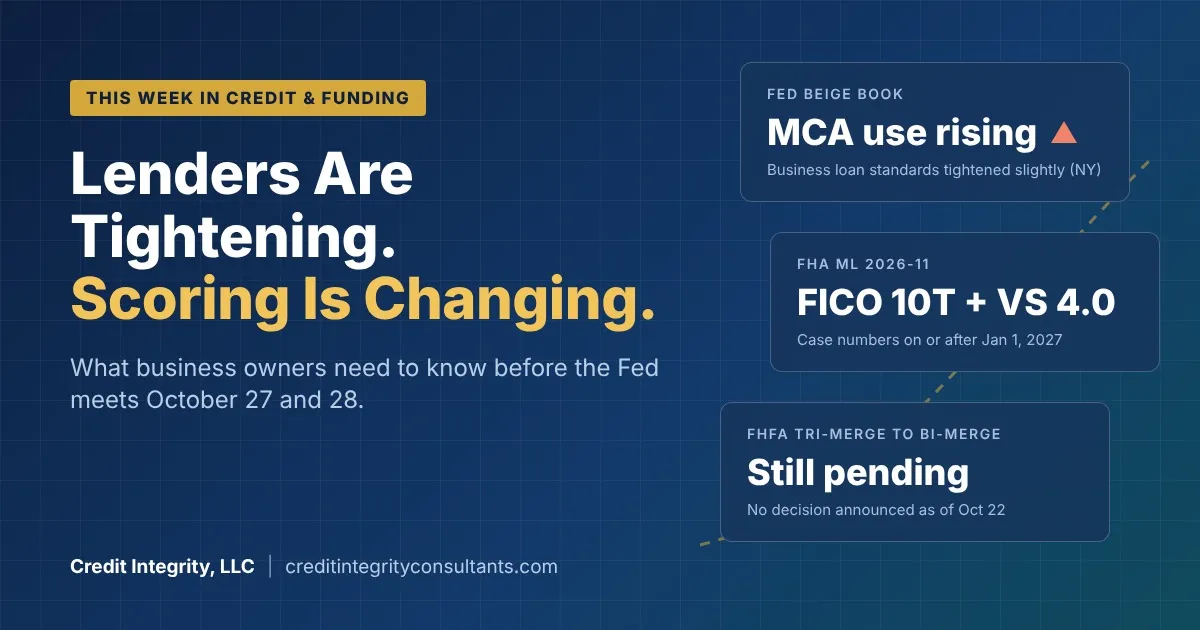
Lenders Are Tightening and Credit Scoring Is Changing: What Business Owners Need to Know Before the Next Fed Meeting
Lenders Are Tightening and Credit Scoring Is Changing: What Business Owners Need to Know Before the Next Fed Meeting
The Federal Reserve's latest field report shows small businesses leaning on expensive cash advances while some banks tighten business loan standards. At the same time, the rules for how your personal credit gets scored on a mortgage are being rewritten. Here is what moved, what it means for your next application, and what to do before the Fed meets on October 27 and 28.
This Week in Credit & Funding
1. The Fed's Beige Book flags merchant cash advances and tighter business credit
What happened: The Federal Reserve released its October Beige Book on October 14, based on reports gathered through October 5. In the Kansas City district, organizations serving small businesses reported "deteriorating financial conditions for their clients," and said small businesses were "increasingly seeking liquidity through merchant cash advances (MCAs)." The report noted that "the high cost of MCAs and the lack of education about this funding product" made matters worse. New York reported that credit standards "tightened slightly for business loans and commercial mortgages," and Chicago said business loan demand rose slightly while "loan quality declined slightly."
Why it matters: When banks tighten, owners who are not prepared get pushed toward the most expensive money on the market. An MCA can solve a payroll problem this week and create a cash flow problem for the next six months. Daily or weekly remittances also show up on your bank statements, and the next underwriter will see them.
What to do: Before you sign any advance, calculate the total payback in dollars, not just the factor rate, and compare it to a line of credit or term loan. If you already have an MCA, map the payoff date and plan your next bank application for after it clears.
2. FHA will accept FICO 10T and VantageScore 4.0 starting January 1, 2027
What happened: On October 8, HUD issued Mortgagee Letter 2026-11. For FHA case numbers assigned on or after January 1, 2027, lenders can use FICO 10T and VantageScore 4.0 alongside Classic FICO. FHA notes these newer models use trended credit data and can factor in information such as rent and utilities. Lenders must use the same model types for all borrowers on a loan and cannot shop for the most favorable score. The lowest qualifying score still sets the transaction, a tri-merge credit report is still required, and FHA's minimum score thresholds did not change.
Why it matters: Many owners buy their first property, or a home that doubles as an office, with FHA financing. Trended models look at how your balances move over time, not just a snapshot. An owner who carries business expenses on personal cards and pays them down only at quarter end can look riskier under a trended model than under Classic FICO.
What to do: Watch your personal revolving balances month to month, not just on the day you apply. Move recurring business spending onto business accounts that report to business bureaus, so your personal profile is not carrying the company.
3. The bi-merge decision is still pending
What happened: On October 1, HousingWire relayed a Bloomberg report that FHFA planned to direct Fannie Mae and Freddie Mac to accept credit reports from two bureaus instead of three, with an announcement possible as soon as October 12. That did not happen. FHFA Director Bill Pulte canceled his appearance at the Mortgage Bankers Association's annual convention in Chicago, and no decision was announced. MBA CEO Bob Broeksmit said the specific reform is "still being worked out."
Why it matters: If lenders can pull two of the three bureaus, the report you never check could be the one that prices your loan, or it could be the one left out. You will not get to choose which two.
What to do: Treat Equifax, Experian, and TransUnion as equally important. Review all three for accuracy now, and dispute genuine errors directly with the bureau that reports them.
4. Big banks are still writing SBA loans
What happened: On October 20, U.S. Bank reported a record $943 million in SBA 7(a) loans for fiscal 2026, which ended September 30. That was up 8.2% from the prior year and placed the bank fourth nationally among 7(a) lenders by loan count and dollar volume.
Why it matters: Tighter rules have not shut the SBA door. They have raised the bar. Lenders with the volume to grow are still approving owners who show up with clean, complete files.
What to do: If an SBA loan is in your next 12 months, start building the package now: three years of business tax returns, year-to-date financials, a current debt schedule, and a personal financial statement that matches your credit reports.
Underwriter's Take
When I reviewed files, a merchant cash advance on the bank statements was never an automatic decline, but it always started a conversation I did not want to have. Daily debits tell an underwriter that cash flow was tight enough to accept expensive money, and they reduce the cash available to service a new loan. Stacked advances were worse, because they suggest the business was refinancing one problem with another. The owners who got approved explained the advance, showed it was paid off or nearly paid off, and proved that the issue that caused it was fixed. Lenders do not just read your credit score. They read your bank statements like a diary.
Action Steps This Week
Pull all three personal credit reports. With bi-merge and new scoring models on the way, any one bureau could drive your next mortgage or personal guarantee decision.
Check your business credit files. Review your Dun & Bradstreet, Experian Business, and Equifax Business profiles for correct legal name, address, and industry codes, and confirm your net-30 vendors are reporting.
Audit your bank statements like an underwriter. Look at the last three months for overdrafts, cash advance debits, and unexplained transfers. Fix what you can before you apply.
Price every funding option in total dollars. Compare the full payback on any advance to the total interest on a line of credit or term loan.
Plan around October 27 and 28. The Fed meets next week. If you have a variable-rate line or SBA loan, recalculate your payment now so a rate move does not surprise you.
Get Funding-Ready With Credit Integrity
The owners who get the best terms are the ones who prepare before they need the money. Start with a Business Credit Assessment or book a consultation with Credit Integrity to see where your business credit, personal credit, and financials stand. Then use Lendavo to track your Funding Ready Score and SBA Readiness Score, and let FundSmart AI match you with funding options that fit your profile.
This post is for educational purposes only and is not legal, tax, or financial advice.
Sources
The Beige Book: Summary of Commentary on Current Economic Conditions, October 2026 (Federal Reserve)
FHA Updates Credit Score Methodology to Accommodate FICO 10T and VantageScore 4.0 (Alston & Bird)
FHFA to Move Fannie, Freddie to Bi-Merge Credit Checks (HousingWire)
Pulte Bows Out of Hotly Anticipated MBA Annual Appearance (Scotsman Guide)
U.S. Bank Boosts SBA Lending to a Record $943 Million in 7(a) Loans (U.S. Bank)
Federal Reserve Board Calendar: October 2026 (Federal Reserve)
