New Tip Credit Rules, Diesel Tax Relief, and Smarter Payroll Tools: What Small Business Owners Need to Do Before Year-End
New Tip Credit Rules, Diesel Tax Relief, and Smarter Payroll Tools: What Small Business Owners Need to Do Before Year-End
Washington changed two rules this month that hit restaurants, salons, contractors, and anyone running trucks or equipment. At the same time, payroll software keeps getting more automated, and the Q3 Form 941 is due in one week. Here is what happened, why it matters, and what to do about it.
This Week in Bookkeeping & Payroll
1. The DOL dropped the 80/20 approach for tipped workers
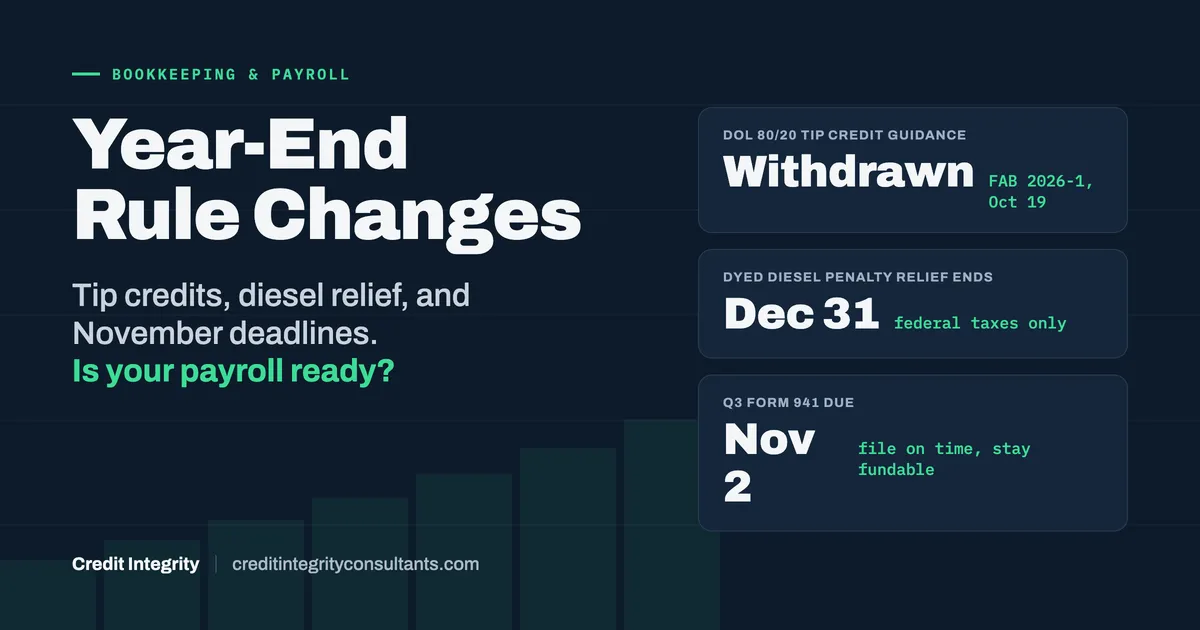
What happened: On October 19, the Department of Labor's Wage and Hour Division issued Field Assistance Bulletin 2026-1. It withdrew three opinion letters from 1979, 1980, and 1985 and confirmed that the old 80/20 guidance no longer reflects its policy. The test now is whether the employee works in a tipped occupation, not whether each task produces tips. Work in a separate, non-tipped job still requires the full minimum wage for those hours. The DOL says a new proposed rule on tipped employees is coming, with a public comment period.
Why it matters: If you take a tip credit (paying as little as $2.13 an hour in federal cash wages), you no longer have to clock every minute of side work against a percentage cap. But the line between a related duty and a separate job still exists, and getting it wrong means back wages. Many states also set their own tipped wage rules, and some do not allow a tip credit at all.
What to do: Do not change pay practices on federal guidance alone. Confirm your state's rules first. Then set up separate pay codes for tipped work and any non-tipped role so your records show exactly which hours carry the tip credit.
2. The IRS paused penalties on dyed diesel used on highways
What happened: Following an October 5 Executive Order, the IRS announced on October 14 that it will not impose penalties on dyed diesel fuel sold for or used in highway vehicles nationwide. The relief is retroactive to October 1 and runs through December 31, 2026. On October 21, the IRS followed up with temporary relief from certain fuel-use reporting and recordkeeping requirements. The relief covers federal taxes only, not state fuel taxes or penalties.
Why it matters: Contractors, landscapers, farms, and fleet operators may be buying fuel differently for the rest of the year. That changes your fuel cost per gallon and your excise tax picture, and it ends on a fixed date.
What to do: Check your state's position before you change fueling habits. Track every relief-period fuel purchase in its own account or class so you can separate it cleanly on January 1 and answer questions from your tax professional. Watch for the IRS guidance it promised on Form 720.
3. Gusto rolled out multi-location payroll and AI connections
What happened: At its Fall Showcase on October 22, Gusto announced a set of small business features. They include one payroll run for hourly employees working across state or city lines, with taxes calculated and filed for each work location. Owners can also tag hours to projects and clients to see labor cost per job, and invoice ingestion reads uploaded contractor invoices and prefills the paysheet. Gusto can now connect to AI tools such as Claude and ChatGPT for payroll questions and reports, with every change requiring owner approval. A new Business Compliance product handles state tax registration and annual report filing.
Why it matters: Multi-state payroll mistakes are some of the most expensive to unwind, and job-level labor cost is the number most service businesses never see. Automation helps, but it only works on accurate setup.
What to do: If you have employees in more than one state or city, confirm each one's work location is correct in your payroll system before year-end. Before connecting any AI tool to payroll, decide who on your team is allowed to approve changes.
Tips to Keep Your Books Clean
Load 2027 state minimum wages now, not on January 2. Several states raise their minimums on January 1, 2027, including Colorado ($15.71), Connecticut ($17.48), Michigan ($15.00), Rhode Island ($17.00), Virginia ($13.75), and Washington ($17.73). Check your state and city rates, update pay rates in your system, and adjust your 2027 labor budget before you set prices for the new year.
Push a W-4 and estimated tax check before the last payrolls of the year. In its October 23 reminder, the IRS urged taxpayers to review withholding and make estimated payments during the year to avoid surprises. Remind employees that a new Form W-4 is how they change withholding. If you are self-employed or take owner distributions, confirm with your tax professional that your estimated payments match what you actually earned this year.
Reconcile payroll liability accounts before you file the Q3 941. Your payroll tax liability accounts should zero out after each deposit. A leftover balance means a missed deposit, a double payment, or a miscoded entry. Find it now, while the quarter is still fresh.
Treat clean books and on-time payroll as part of your business credit profile. Lenders underwrite your financial statements, tax returns, and bank activity, and they expect all three to tell the same story. Late payroll deposits create penalties and, if unpaid, can lead to a federal tax lien that surfaces in underwriting. Monthly closes, reconciled accounts, and payroll filed on time are what make a business fundable when you apply.
Keep a paper trail for any rule change you act on. Whether it is the new tip credit guidance or the diesel relief, save the bulletin or news release with the date you relied on it. If a rule changes again or an auditor asks, you can show why you did what you did.
Upcoming Deadlines
Date | What is due | Who it applies to |
|---|---|---|
Nov 2, 2026 | Form 941 for Q3 (July to September). October 31 falls on a Saturday, so the deadline moves to Monday | All employers filing quarterly |
Nov 2, 2026 | Q3 FUTA deposit, if accumulated FUTA liability is over $500 | Employers who pay federal unemployment tax |
Nov 10, 2026 | Form 941 for Q3, if all Q3 tax was deposited on time and in full | Employers current on deposits |
Nov 10, 2026 | Employees report October tips of $20 or more to their employer | Businesses with tipped employees |
Nov 16, 2026 | October Social Security, Medicare, and withheld income tax deposit. November 15 falls on a Sunday | Monthly schedule depositors |
Looking ahead: the federal dyed diesel relief ends December 31, 2026, and new state minimum wages take effect January 1, 2027.
Close 2026 With Payroll You Can Defend
Rule changes like these reward owners whose books are already organized and punish the ones still catching up. Credit Integrity handles your bookkeeping and payroll so pay codes are set up right, filings go out on time, and your financials are ready the moment a lender asks. Our bookkeeping and payroll services come bundled with business credit consulting, so the same clean books that keep you compliant also build your path to capital.
Book a consultation at creditintegrityconsultants.com and head into 2027 ready.
This post is for educational purposes only and is not tax or legal advice. Consult a qualified tax professional about your specific situation.
Sources
Field Assistance Bulletin No. 2026-1 (U.S. Department of Labor, Wage and Hour Division)
DOL rescinds potentially misread tip rule opinion letters (HR Dive)
Federal Employment Law Update for October 23, 2026 (National Law Review)
IR-2026-122: IRS provides dyed diesel fuel relief related to excise tax (IRS)
Gusto Touts New Products and Features for Small Businesses (CPA Practice Advisor)
IRS reminder: Year-round tax planning can make filing easier (IR-2026-128)
2027 State-by-State & Local Minimum Wage Changes and Posting Updates (Experian Employer Services)
Publication 15 (2026), Circular E, Employer's Tax Guide (IRS)
