Blog
Q4 Payroll Checklist: 3 Deadlines, New W-2 Codes, and the Scams Targeting Your Payroll
Q4 Payroll Checklist: 3 Deadlines, New W-2 Codes, and the Scams Targeting Your Payroll
The fourth quarter is where sloppy books get expensive. Between now and Thanksgiving you have three federal payroll and filing dates, a W-2 that looks different than any you have filed before, and scammers who know exactly when payroll teams are busiest. Here is what changed, why it matters, and what to do this week.
This Week in Bookkeeping & Payroll
1. Hiring cooled, but small business revenue ticked up
What happened: The Bureau of Labor Statistics reported on October 2 that U.S. payrolls grew by only 29,000 jobs in September. Unemployment held at 4.2%, and average hourly earnings were up 3.0% from a year earlier. The Intuit QuickBooks Small Business Index for September showed businesses with 1 to 9 employees lost 7,000 jobs from August, while average real monthly revenue rose 1.68%.
Why it matters: Small employers are doing more with fewer people. Revenue is moving up while headcount slips, which tells you owners are protecting margins and staying cautious on hiring.
What to do: Before you add or cut staff in Q4, pull your labor cost as a percentage of revenue for the last three months. If you cannot get that number in under five minutes, your books are not set up to support the decision.
2. The IRS is warning payroll teams about W-2 and direct deposit scams
What happened: The IRS kicked off Cybersecurity Awareness Month on October 2 with a reminder that payroll, HR, and business staff should watch for phishing, fake invoices, and W-2 and payroll schemes aimed at employee data, credentials, or money. The agency told businesses to verify any request to change employee or payment information through a trusted channel before acting.
Why it matters: One fake "please update my direct deposit" email can send a full paycheck to a criminal. You still owe the employee, and you rarely get the money back.
What to do: Put a callback rule in writing. Any change to bank details, for an employee or a vendor, gets confirmed by phone using a number already on file, never a number in the email. Turn on multifactor authentication for your payroll platform, bank, and IRS Business Tax Account. Report suspicious contacts at IRS.gov/SubmitATip.
3. QuickBooks rolled out new payroll and job costing tools
What happened: Intuit's October 6 product update added CSV and Excel payroll uploads for QuickBooks Workforce Premium and Elite users, the ability to split a paycheck across multiple service items and carry it into job costing reports, and a tool to import employee records and year-to-date payroll history from ADP or Gusto.
Why it matters: Job costing is where most service businesses find out which jobs actually make money. Tying payroll directly to service items closes a gap many owners have been patching with spreadsheets.
What to do: If you are on QuickBooks payroll and bill by job or project, set up service items now so Q4 data is clean going into year-end. If you plan to switch payroll providers, do it on a quarter boundary so your 941s stay simple.
4. On the radar: your 2026 W-2 and 1099s will look different
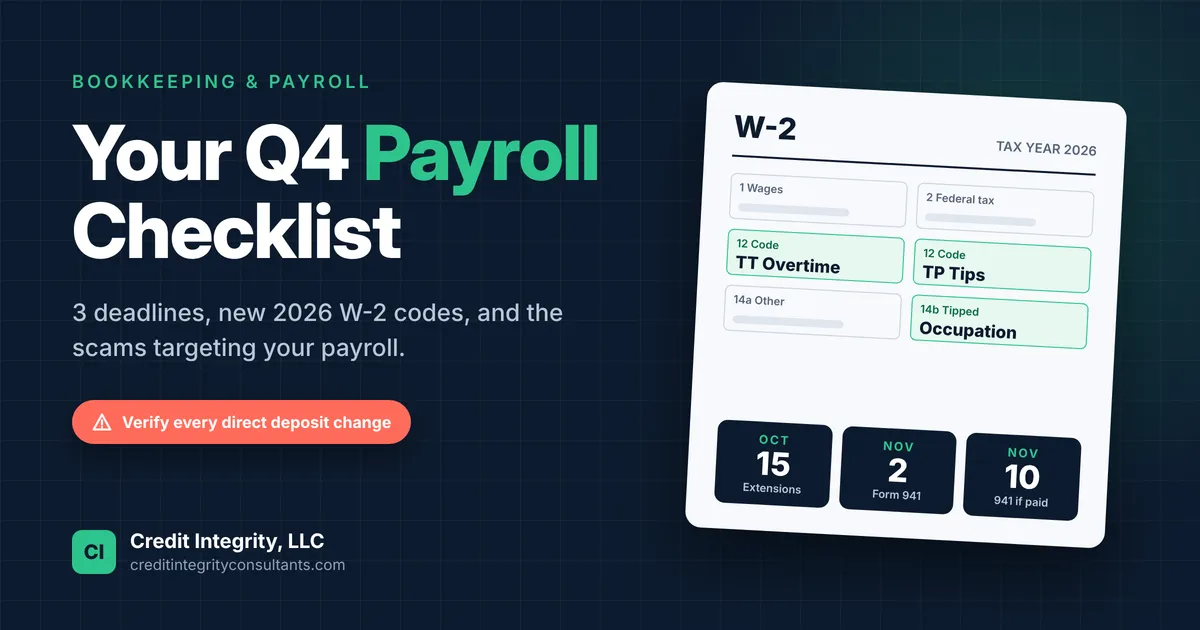
What happened: The IRS final 2026 W-2 instructions add new box 12 codes: TT for qualified overtime compensation, TP for cash tips reported to the employer, and TA for employer contributions to Trump accounts. Box 14 is now split into 14a and 14b, with 14b used for Treasury Tipped Occupation Codes. Separately, the reporting threshold for Forms 1099-NEC and 1099-MISC rose to $2,000 for payments made in 2026.
Why it matters: If your payroll system has not been tracking the overtime premium and tips separately all year, you will be reconstructing it in January. That is when errors happen.
What to do: Ask your payroll provider today whether overtime premium and tips are being captured for the new codes. Run a year-to-date report and spot-check it against your time records. For contractors, collect missing W-9s now, before the January rush.
Tips to Keep Your Books Clean
Reconcile every account through September 30 this week. Bank, credit cards, loans, and payroll clearing accounts. Your Q3 941 has to tie to your books. If it does not, find out why before you file, not after a notice shows up.
Separate the overtime premium from regular pay in your payroll setup. The new W-2 code TT reports the premium portion of qualified overtime. If your system lumps all hours together, fix the pay codes now so the last two and a half months of the year are right.
Treat worker classification as a live issue. The Department of Labor's proposed independent contractor rule, announced in February, is still at the proposal stage. Until a final rule lands, document why each contractor is a contractor: who controls the work, who carries the profit or loss, and whether the relationship is ongoing.
Remember that lenders read your books before they read your application. Funding decisions lean on financial statements, tax returns, and bank activity that tell the same story. Payroll taxes filed and paid on time, books closed monthly, and a P&L that matches your bank deposits are what make a business look fundable. Late 941s or unreconciled accounts raise questions that slow down approvals or stop them entirely. Clean books are also the foundation of a strong business credit profile, because every trade line and loan you pursue gets underwritten against them.
Lock down who can change payroll. Limit admin access in your payroll and banking platforms to the people who need it, turn on multifactor authentication, and review the access list every quarter.
Upcoming Deadlines
Date | What is due | Who it applies to |
|---|---|---|
Oct 15, 2026 | Extended 2025 federal income tax returns (Form 1040, and Form 1120 for calendar-year C corporations) | Anyone who filed an extension. An extension gave more time to file, not to pay |
Nov 2, 2026 | Form 941 for Q3 (July to September). October 31 falls on a Saturday, so the deadline moves to Monday | All employers filing quarterly |
Nov 2, 2026 | Q3 FUTA deposit, if your accumulated FUTA liability is over $500 | Employers who pay federal unemployment tax |
Nov 10, 2026 | Form 941 for Q3, if you deposited all Q3 tax on time and in full | Employers current on deposits |
Looking ahead: 2026 Forms W-2 are due to employees and the SSA by February 1, 2027. Form 1099-NEC follows the same January 31 rule, which also rolls to February 1 because January 31, 2027 is a Sunday. Start the prep now.
Get Year-End Ready With Credit Integrity
Year-end does not have to be a scramble. Credit Integrity handles your bookkeeping and payroll so your filings go out on time, your W-2s are right the first time, and your financials are ready when a lender asks for them. Our bookkeeping and payroll services come bundled with business credit consulting and the Lendavo funding-readiness platform, so the same clean numbers that keep you compliant also build your path to capital.
Book a consultation at creditintegrityconsultants.com and close out 2026 with books you can stand behind.
This post is for educational purposes only and is not tax or legal advice. Consult a qualified tax professional about your specific situation.
Sources
The Employment Situation, September 2026 (U.S. Bureau of Labor Statistics)
IRS reminder: Cybersecurity Awareness Month offers simple steps to protect tax data (IR-2026-119)
QuickBooks Online new features and updates, October 2026 (Firm of the Future)
Instructions for Forms 1099-MISC and 1099-NEC (Rev. December 2026) (IRS)
Publication 15 (2026), Circular E, Employer's Tax Guide (IRS)
Key IRS Deadline Looms for as Many as 20 Million Tax Filers (CPA Practice Advisor)

What others are saying

Quick, Easy, and Stress-Free!
"Thanks to Credit Integrity, I secured the funding I needed to expand my business. The process was quick, easy, and stress-free!"
- Sarah M.
Equipment Financing


Finally...No More Struggling!
"I was struggling to find the right loan until I found Credit Integrity. They matched me with the perfect lender, and now my business is thriving!"
- James T.
business line of credit

Incredibly Helpful
"The team at Credit Integrity was incredibly helpful. They explained everything clearly and made the entire process so simple.
- Maria L.
SBA LOAN
Your Financial Profile Is Either Working For You or Against You. Let's Fix That.
Book a free discovery call to see what you qualify for today and get a clear plan for your books, your credit, and your next approval.

Bookkeeping, payroll, business credit, and funding solutions built for business owners who are ready to grow with confidence at every stage.
Services
Company
Contact
© Credit Integrity. 2026. All Rights Reserved.